Wednesday, August 5, 2015

About That Vase


I was pretty direct with God in Monday's post, wasn't I? You break it, you buy it. Meaning, of course, if the universe is flawed, God has to be held responsible. But what if the "template" was always for us (humanity) to integrate the spiritual with the material? If God is ONE (unified, whole) how would it be possible to observe or experience other aspects of Oneself? Fragmentation was required, division necessary. In a word, duality. So the physical world came to be. And eventually, us.

Understand that fragmentation was contingent on the left hand not knowing what the right hand was doing. Only this could insure an impartial, unbiased flow of information from experiences that, by their very nature, would be partial and biased. Because the One had to imagine something other than Itself, (ergo a clone) the only way possible was through a limited and seemingly separate expression of It's consciousness; with these limitations and separations becoming more pronounced as they filtered down through the diverse manifestations of the One. (think; man--dog--flower--rock)

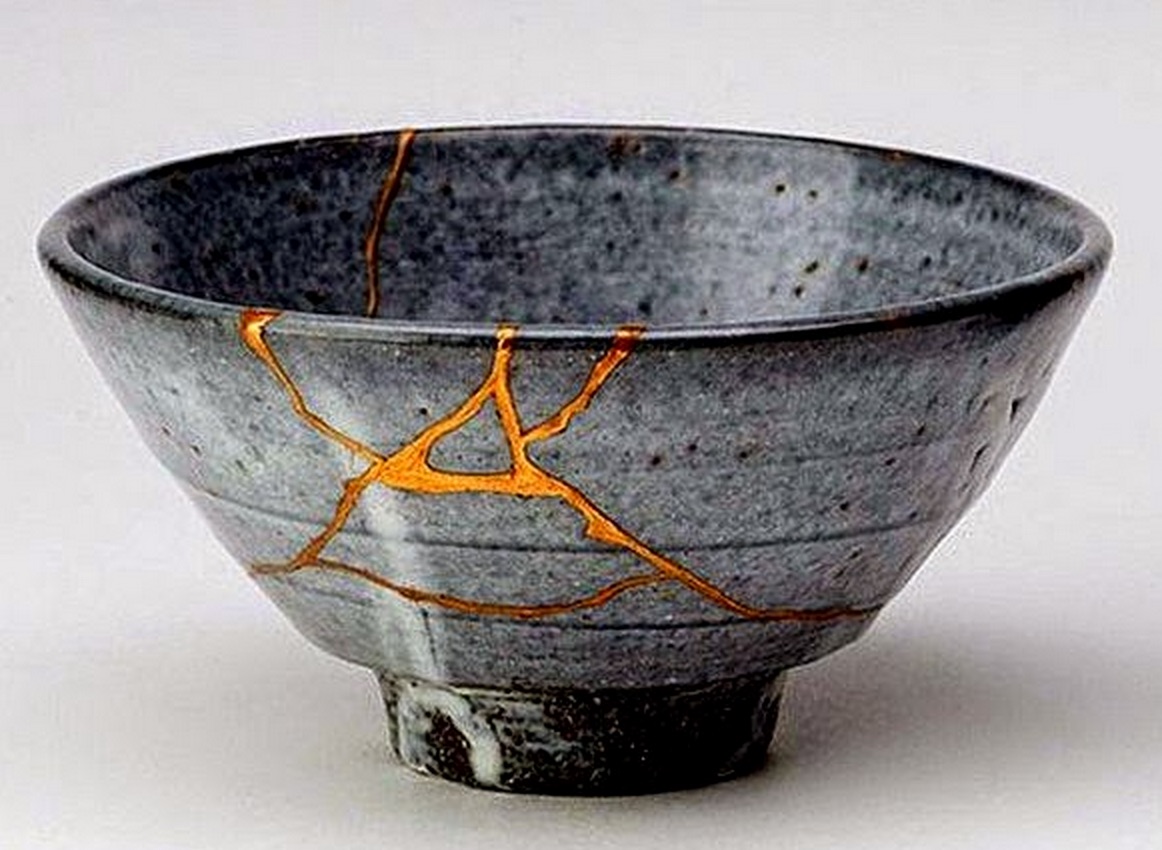
And this is where we come in. With our understanding we can observe and experience fragmentation as a revelation of the One. The bowl pictured above is an image of kintsugi, the Japanese art of pottery repair. (see; Wabi Sabi 2-13-14) It is an invaluable aid to understanding what we do with the broken pieces of the vase. We put them back together, more beautiful than before. In this way we answer the two most vexing questions that mankind has ever posed: "who am I" and "what am I doing here."


Monday, August 3, 2015

You Break It You Buy It

"And God saw every thing he had made, and, behold, it was very good. And the evening and the morning were the sixth day." Genesis 1:31

"And it repented the Lord that he had made man on the earth, and it grieved him at his heart. And the Lord said, I will destroy man whom I have created from the face of the earth, both man and beast, and the creeping thing, and the fowls of the air; for it repenteth me that I have made them." Genesis 6:6-7

Wow! Didn't take long for things to go to hell in a hand basket, did it? A mere 5 chapters after God declared, "it was very good," he is ready to wash his hands of the whole thing. (literally--I mean it was a flood, after all) Now man I can understand. We exercised free will in the garden and had the temerity of having daughters that were attractive to the sons of God. Who promptly came down and took the daughters of men as wife's, and started producing off-spring. (Gen. 6:2-4) Talk about your double standards! Apparently God felt it was okay for his "sons" to be reckless and carnal-driven, but the "wickedness of man was great in the earth." (verse 5) My question is, what did the animals do that they were included in the destruction? Were they wicked too?

Another question that I have is; what punishment did the "sons of God" incur? The text is silent until the New Testament. (see; 2nd Peter 2:4-5) Supposedly, "...God spared not the angels that sinned, but cast them down to hell, and delivered them into chains of darkness, to be reserved until judgement." Chained? Everything I've ever heard about them is that they are a pretty active bunch. Who was Jesus exorcising out of people in the Gospels (Mark 5:1-20 as just one example) if not for fallen angels? Did they somehow get time off for good behavior? What were they doing going around possessing people when their (supposedly) chained up?

The larger point is this: did God get it wrong when he said it was "very good." If God did create the world and everything in it, he's accountable for it. He is either omniscient or he's not, right? If he's not omniscient, then he's not really God. If he is "God," he knew what was going to happen and still declared it very good. You say, 'hold on there Pat, we had free will. Don't you know choices come with consequences.' Fair enough! So too, with God. The consequences of free will is that bad decisions are going to be made. If your child touches a hot stove when you've told them not to, do you wipe them off the face of the planet for disobeying you? How about when an adult takes hold of a child's hand and places it in a fire, do you drown the child for disobedience? (the adult being a son of God and the child a daughter of man) If you go into a store and knock an expensive vase from a table, do you blame the pieces of broken pottery on the floor? Stupid vase...it chose to break! No, you're the one who set things in motion and the consequences are your responsibility. So too, with God.

Sunday, August 2, 2015

Savvy?

God is of no importance unless He is of supreme importance. ~Abraham Joshua Heschel

Friday, July 31, 2015

Self-importance

One day, the governor of Kyoto called upon Keichu, the great Meiji Zen master. One of Keichu's attendants brought the governor's calling card to Keichu. The card read, "Kitagaki, Governor of Kyoto."

"Never heard of him," said Keichu to the attendant. "I have no business with nobodies: tell him to go away."

The attendant returned to the governor with the story. "My mistake," said the governor, and taking the card he scratched out the words, "Governor of Kyoto." Then he handed the card back to the attendant and said, "Please ask your teacher again."

The attendant returned to Keichu. "Oh, that Kitagaki!" he exclaimed. "Bring him here! I want to see that fellow!" 


Retold by Paul Jordan-Smith from "Zen Koans" by Gyoma M. Kubose

Thursday, July 30, 2015

Master Meister

                                                                       Dedicated to J.A.H.

Not that one should give up, neglect or forget his inner life for a moment, but he must learn to work in it, with it and out of it, so that the unity of his soul may break out into his activities and his activities shall lead him back to that unity. In this way one is taught to work as a free man should (dispassionately). Keep your eye on the functioning of your inner life and start from there--to read, or pray, or do any needed outward deed. If, however, the outward life interferes with the inner, then follow the inner; but if the two can go on together, that is the best of all and then the man is working together with God.

~Meister Eckhart   From "The Talks of Instruction."

(I am proud of you Aaron)

Wednesday, July 29, 2015

New and Improved

If you look at the letterbox picture (bottom left) at the top of the page, you will now see three new tabs: Gift Gratitude God. That was the original name of my web site and the philosophical theology at it's heart. After its second year in existence, I declined to pay the annual "domain name" cost and had Gwenn change the name to WPGrogan. Drab and dreary perhaps, but it was free! Regardless of the name, every blog posted had Gift Gratitude God as it's center, it's core. It is what I promote, it is what I teach, it is what I believe. (no matter how imperfectly)

The change was necessary because Gwenn told me that the continuation of the web site (which did appear in most browsers as the second link available under my name) was totally arbitrary and could disappear at any time. We didn't own the rights and only the anomalous nature of the title protected it from (possible) removal. So Gwenn, over the last seven days, dovetailed the main ingredients of the web site into the blog. And I couldn't be happier! It is my hope that you will jump at the opportunity to "check under the hood" and "take it out for a spin." Enjoy your Wednesday!

The Question

Now there lived in Damascus, at the height of that great city's glory, a famous Imam. This celebrated man, equally at ease in caliph's palace or monk's retreat, had obscure origins; yet so great was his piety that Allah always seemed to favor him, for he rose far in the world.

One day, the reigning caliph decided to hold a triumphant procession for his Imam: "As a mark of our esteem for your piety," he proclaimed. The Imam took the costly and elaborate presentations calmly, for he was a man who thought of himself without vanity. Finally, all was in readiness and, although it was the time of rains, the morning of the procession dawned bright and clear--still another sign of Allah's approval upon which all commented.

Through the winding streets of Damascus moved the colorful procession. First came the wild desert sheiks in striped robes of red and yellow, mounted on small-headed horses. The more sophisticated nobles followed them on foot, their heads bent piously down, the gold in their tunics glittering in the sun. After the nobles came the holy men of the city and with them, in their center, the Imam clothed in robes of snowy white linen.

The citizens of Damascus lined the streets, cheering and throwing sprigs of jasmine and clusters of roses. As the Imam approached, the shouts of praise rose to new heights and the heavens seemed to rain flowers. At such acclaim, the Imam's heart swelled with joy and satisfaction, although his face did not betray him.

Now it happened that just as the procession was approaching the palace gates, outside of which the caliph and his retinue waited to greet him, the Imam heard within him a Voice that seemed to well from his very bowels: "And have you," It asked, "forgotten Me so soon?"

As though struck by a blow on the back of the head, the Imam fell to the ground. But before anyone could touch him, he leapt up and fled through the crowds, burning with a terrible remorse. Far he fled into the desert and swiftly, as though hot coals filled his sandals. Finally, exhausted and unable to go further, he halted at an abandon hut. The Terrible Voice still filled his ears with Its sound. The tears still streamed from his eye's. The Imam vowed that never again would he enter a city of men until he had cleansed all falseness and vanity from his heart.

For five long years the Imam lived in a little hut, meditating, praying, and praising Allah. For ten years more, he roamed the desert and passed through small towns, aiding those he could help, giving comfort to all.

Then one day, by chance, his path led him once more into the city of Damascus and through the very gate by which he had fled fifteen years before. But how the Imam had changed! A diet of herbs and berries had starved the flesh from his frame; prickly vines and desert thorns and stones had scarred him from head to toe. The once radiant Imam was now more decrepit and shattered than the poorest of beggars in the poorest of villages.

When the smaller children caught sight of this ragged apparition, they screamed and fled; the older ones threw sharp-edged stones. The grown-ups, citizens of Damascus who fifteen years before had strewn the Imam's way with flowers, now pelted him with pieces of filth; and instead of praises, filled his ears with their jeers and gibes. The poor Imam's heart swelled with sadness and despondency and he hung his head low.

Just as he dragged himself past the palace gates, where the guards stood with raised sabers to drive him off, the Imam again heard that terrible Voice, welling from deep within him; "And have you," It asked, "forgotten Me so soon?"

~Elizabeth Retivov  Stories from an Eastern Coffeehouse (N.Y. Hedgehog Press 1963)