God whispered, "Write."
I laughed, "Why? I've told them what they need to know and they don't understand."
She said, "It doesn't matter. Try again."
"They are locked in their paradigms," I replied. "And they are really, really stupid. I am sorry, but they are."
A smile flickered as He asked, "And you?"
"Less so."
"Tell them how."
1) God isn't anything that you can describe. God is limitless.
2) You get to see aspects of God.
3) The aspects you see are your life experiences.
4) The experiences you have are dynamic--not static.
5) This means experiences are SUBJECT TO CHANGE!
6) You can change (alter, amend, modify, revise or redact) your experience.
7) The quality of change is usually (but not always) subject to your involvement, interest, enthusiasm, adaptability and perseverance.
8) You can view your efforts impersonally. Results are neither endorsements nor rejections.
9) God encompasses whimsy and extravagance. (google; leafy sea dragon) Limitations are the cornerstone of your paradigm.
10) Expect nothing--ask for everything.
"Happy?"
"Are you?"
"Won't do much good."
"We'll see..."
"Ha!"
"I suggest you review # 8."
"Touche."
"...Pat, thanks..."
"Good Lord it wasn't anything..."
"Either am I."
"You can't be anything if you're everything."
"So you did have something to say after all."
"I've already told them that."
"Yeah, but you know how everybody loves Cliffs Notes."

Friday, October 23, 2015


Saturday, September 5, 2015
That Tat
I admire Bekah Miles and I don't wish anything I am about to say to be interpreted as criticism. She is brave to have come forth publicly with her problem. That said, it is important you are aware that 'Save Me' is nothing more than a compelling, seductive, spiritual snare. Those with a conscious spiritual directive (as I assume those who come to this site have) would do well to avoid the pitfall of anything resembling a "messiah complex."
As spiritually driven individuals it is inherent in our nature that we reach out to help others. Success, however, can lead to credit oneself for that which Life does through us. Here the ego plays on our vanity and we start believing we're something we aren't. That it was our power (intellect, wisdom, character) that initiated the transformation, when, in fact, it was our ability to let God (Life) work unopposed by ego that brought about any particular change. Personal feelings of what is best for an individual must be set aside so that their truth emerges--not a confirmation of ours.
What I believe would be beneficial for Bekah to realize is: No one can do it for Bekah but Bekah, so 'Save Me' is misguided. I think she unconsciously realizes this because she is the only one able to read the message Save Me, while everyone else sees I'm Fine. (although it is interesting to me that I'm Fine is harder to detect [not as legible] as Save Me--again, an unconscious clue) The other revealing detail was her use of the word, should. ("when I know I should be happy") Should is a very restrictive word. It reveals how things are suppose to be. If things aren't that way, then something must certainly be wrong. And is so often the case, the individuals blame themselves. (there must be something wrong with me!) Should is a very harsh taskmaster. Much better is replacing the word should with could. Not only in this specific case, but in nearly all situations.
As spiritually driven individuals it is inherent in our nature that we reach out to help others. Success, however, can lead to credit oneself for that which Life does through us. Here the ego plays on our vanity and we start believing we're something we aren't. That it was our power (intellect, wisdom, character) that initiated the transformation, when, in fact, it was our ability to let God (Life) work unopposed by ego that brought about any particular change. Personal feelings of what is best for an individual must be set aside so that their truth emerges--not a confirmation of ours.
What I believe would be beneficial for Bekah to realize is: No one can do it for Bekah but Bekah, so 'Save Me' is misguided. I think she unconsciously realizes this because she is the only one able to read the message Save Me, while everyone else sees I'm Fine. (although it is interesting to me that I'm Fine is harder to detect [not as legible] as Save Me--again, an unconscious clue) The other revealing detail was her use of the word, should. ("when I know I should be happy") Should is a very restrictive word. It reveals how things are suppose to be. If things aren't that way, then something must certainly be wrong. And is so often the case, the individuals blame themselves. (there must be something wrong with me!) Should is a very harsh taskmaster. Much better is replacing the word should with could. Not only in this specific case, but in nearly all situations.
Wednesday, September 2, 2015
I'm Fine Save Me
A young lady (Bekah Miles) has received a great deal of attention for sharing a Facebook post regarding a tattoo she got above her left knee. Read from our point of view it says I'm Fine. From her point of view (looking down) it reads Save Me. She meant for it to be a conversation starter for mental illness.

See her story here...
"To me it means that others see this person that seems okay, but, in reality, is not okay at all. It reminds me that people who may appear happy, may be at battle with themselves." Bekah then goes on to write what depression means to her: "To me, depression is..." concluding with; "Depression is the tears I have because I don't know why I feel so worthless, when I know I should feel happy."
Of course this comes as no surprise to me. (Or you either, if you have been reading this blog.) On October 10th, 2012, I wrote the following in the post Not Good Enough:
"Whenever I engage with an individual on an authentic, genuine level, the deeply ingrained feeling of not being "good enough" will surface. Time and again, over and over, this "hidden" secret comes out. Exploring it's range and scope usually reveals the obstacles that individual is currently dealing with, or has buried to their detriment. It is so prevalent it is predictable."
I wish to be clear; I have no degree in psychology. I am not a trained therapist. What I am is a person who has a relationship with God (or Life, the Presence, Cosmic Consciousness--whatever you wish to call it). Within that relationship certain things are brought to my attention that are obvious. You may disagree with my conclusion or maintain I oversimplify serious mental illnesses. I won't argue with you. But I will ask you this: try it. Put G-G-G to the test. Start by sliding down the page and reading About That Vase (8-5-15) or archiving Wabi Sabi (2-13-14). Read the rest of Not Good Enough. If you are interested, read the entire blog and get a real sense of what it is I'm suggesting. Then come at me with everything you've got! (which, if we're being totally honest, may include a disorder or two of your very own)
--- View the Huffington Post write up of August 31, 2015 ---
See her story here...
"To me it means that others see this person that seems okay, but, in reality, is not okay at all. It reminds me that people who may appear happy, may be at battle with themselves." Bekah then goes on to write what depression means to her: "To me, depression is..." concluding with; "Depression is the tears I have because I don't know why I feel so worthless, when I know I should feel happy."
Of course this comes as no surprise to me. (Or you either, if you have been reading this blog.) On October 10th, 2012, I wrote the following in the post Not Good Enough:
"Whenever I engage with an individual on an authentic, genuine level, the deeply ingrained feeling of not being "good enough" will surface. Time and again, over and over, this "hidden" secret comes out. Exploring it's range and scope usually reveals the obstacles that individual is currently dealing with, or has buried to their detriment. It is so prevalent it is predictable."
I wish to be clear; I have no degree in psychology. I am not a trained therapist. What I am is a person who has a relationship with God (or Life, the Presence, Cosmic Consciousness--whatever you wish to call it). Within that relationship certain things are brought to my attention that are obvious. You may disagree with my conclusion or maintain I oversimplify serious mental illnesses. I won't argue with you. But I will ask you this: try it. Put G-G-G to the test. Start by sliding down the page and reading About That Vase (8-5-15) or archiving Wabi Sabi (2-13-14). Read the rest of Not Good Enough. If you are interested, read the entire blog and get a real sense of what it is I'm suggesting. Then come at me with everything you've got! (which, if we're being totally honest, may include a disorder or two of your very own)
--- View the Huffington Post write up of August 31, 2015 ---
Tuesday, August 11, 2015
Wednesday, August 5, 2015
About That Vase
I was pretty direct with God in Monday's post, wasn't I? You break it, you buy it. Meaning, of course, if the universe is flawed, God has to be held responsible. But what if the "template" was always for us (humanity) to integrate the spiritual with the material? If God is ONE (unified, whole) how would it be possible to observe or experience other aspects of Oneself? Fragmentation was required, division necessary. In a word, duality. So the physical world came to be. And eventually, us.
Understand that fragmentation was contingent on the left hand not knowing what the right hand was doing. Only this could insure an impartial, unbiased flow of information from experiences that, by their very nature, would be partial and biased. Because the One had to imagine something other than Itself, (ergo a clone) the only way possible was through a limited and seemingly separate expression of It's consciousness; with these limitations and separations becoming more pronounced as they filtered down through the diverse manifestations of the One. (think; man--dog--flower--rock)
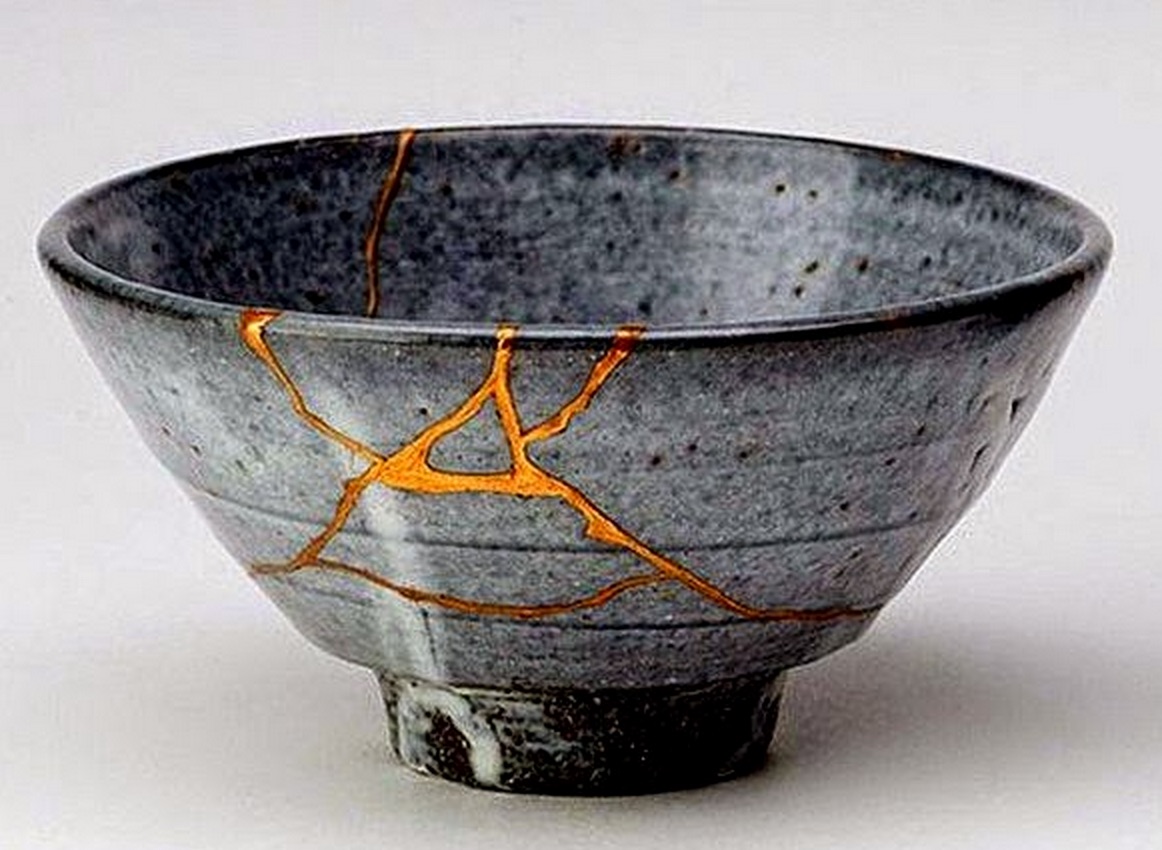
And this is where we come in. With our understanding we can observe and experience fragmentation as a revelation of the One. The bowl pictured above is an image of kintsugi, the Japanese art of pottery repair. (see; Wabi Sabi 2-13-14) It is an invaluable aid to understanding what we do with the broken pieces of the vase. We put them back together, more beautiful than before. In this way we answer the two most vexing questions that mankind has ever posed: "who am I" and "what am I doing here."
Monday, August 3, 2015
You Break It You Buy It
"And God saw every thing he had made, and, behold, it was very good. And the evening and the morning were the sixth day." Genesis 1:31
"And it repented the Lord that he had made man on the earth, and it grieved him at his heart. And the Lord said, I will destroy man whom I have created from the face of the earth, both man and beast, and the creeping thing, and the fowls of the air; for it repenteth me that I have made them." Genesis 6:6-7
Wow! Didn't take long for things to go to hell in a hand basket, did it? A mere 5 chapters after God declared, "it was very good," he is ready to wash his hands of the whole thing. (literally--I mean it was a flood, after all) Now man I can understand. We exercised free will in the garden and had the temerity of having daughters that were attractive to the sons of God. Who promptly came down and took the daughters of men as wife's, and started producing off-spring. (Gen. 6:2-4) Talk about your double standards! Apparently God felt it was okay for his "sons" to be reckless and carnal-driven, but the "wickedness of man was great in the earth." (verse 5) My question is, what did the animals do that they were included in the destruction? Were they wicked too?
Another question that I have is; what punishment did the "sons of God" incur? The text is silent until the New Testament. (see; 2nd Peter 2:4-5) Supposedly, "...God spared not the angels that sinned, but cast them down to hell, and delivered them into chains of darkness, to be reserved until judgement." Chained? Everything I've ever heard about them is that they are a pretty active bunch. Who was Jesus exorcising out of people in the Gospels (Mark 5:1-20 as just one example) if not for fallen angels? Did they somehow get time off for good behavior? What were they doing going around possessing people when their (supposedly) chained up?
The larger point is this: did God get it wrong when he said it was "very good." If God did create the world and everything in it, he's accountable for it. He is either omniscient or he's not, right? If he's not omniscient, then he's not really God. If he is "God," he knew what was going to happen and still declared it very good. You say, 'hold on there Pat, we had free will. Don't you know choices come with consequences.' Fair enough! So too, with God. The consequences of free will is that bad decisions are going to be made. If your child touches a hot stove when you've told them not to, do you wipe them off the face of the planet for disobeying you? How about when an adult takes hold of a child's hand and places it in a fire, do you drown the child for disobedience? (the adult being a son of God and the child a daughter of man) If you go into a store and knock an expensive vase from a table, do you blame the pieces of broken pottery on the floor? Stupid vase...it chose to break! No, you're the one who set things in motion and the consequences are your responsibility. So too, with God.
"And it repented the Lord that he had made man on the earth, and it grieved him at his heart. And the Lord said, I will destroy man whom I have created from the face of the earth, both man and beast, and the creeping thing, and the fowls of the air; for it repenteth me that I have made them." Genesis 6:6-7
Wow! Didn't take long for things to go to hell in a hand basket, did it? A mere 5 chapters after God declared, "it was very good," he is ready to wash his hands of the whole thing. (literally--I mean it was a flood, after all) Now man I can understand. We exercised free will in the garden and had the temerity of having daughters that were attractive to the sons of God. Who promptly came down and took the daughters of men as wife's, and started producing off-spring. (Gen. 6:2-4) Talk about your double standards! Apparently God felt it was okay for his "sons" to be reckless and carnal-driven, but the "wickedness of man was great in the earth." (verse 5) My question is, what did the animals do that they were included in the destruction? Were they wicked too?
Another question that I have is; what punishment did the "sons of God" incur? The text is silent until the New Testament. (see; 2nd Peter 2:4-5) Supposedly, "...God spared not the angels that sinned, but cast them down to hell, and delivered them into chains of darkness, to be reserved until judgement." Chained? Everything I've ever heard about them is that they are a pretty active bunch. Who was Jesus exorcising out of people in the Gospels (Mark 5:1-20 as just one example) if not for fallen angels? Did they somehow get time off for good behavior? What were they doing going around possessing people when their (supposedly) chained up?
The larger point is this: did God get it wrong when he said it was "very good." If God did create the world and everything in it, he's accountable for it. He is either omniscient or he's not, right? If he's not omniscient, then he's not really God. If he is "God," he knew what was going to happen and still declared it very good. You say, 'hold on there Pat, we had free will. Don't you know choices come with consequences.' Fair enough! So too, with God. The consequences of free will is that bad decisions are going to be made. If your child touches a hot stove when you've told them not to, do you wipe them off the face of the planet for disobeying you? How about when an adult takes hold of a child's hand and places it in a fire, do you drown the child for disobedience? (the adult being a son of God and the child a daughter of man) If you go into a store and knock an expensive vase from a table, do you blame the pieces of broken pottery on the floor? Stupid vase...it chose to break! No, you're the one who set things in motion and the consequences are your responsibility. So too, with God.
Sunday, August 2, 2015
Subscribe to:
Posts (Atom)